
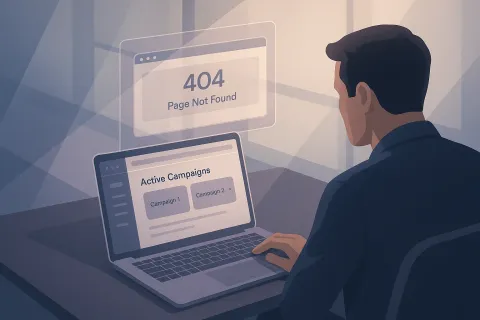
Some mistakes are expensive. Others are expensive and invisible. Sending paid traffic to a page that does not exist belongs to the second group: the campaign keeps running, the clicks keep coming in, and the budget disappears while users hit a dead end.
It is a frustrating kind of failure because the intent was already there. The user clicked. The ad did its job. And then the destination failed at the exact moment it mattered most. That is why broken landing pages in active campaigns are not a minor technical issue; they are a direct leak in acquisition.
Why a 404 in an active campaign hurts more than a normal broken link
A broken link on an old blog post is a problem. A 404 in a live campaign is a different category of damage. You are paying for the visit, so every failed load has a financial cost. At the same time, the user experience is interrupted before any value is delivered, which can damage trust and reduce the chance of future engagement.
There is also a hidden operational cost. Teams often assume the ad platform is underperforming, when the real issue is the destination URL. That means budget decisions are made on incomplete information, and the same mistake can stay active far longer than it should.
What usually causes campaign URLs to break
The cause is not always obvious. A page may have been renamed during a site update, removed after a redesign, or replaced without updating every active campaign. In other cases, tracking parameters are built incorrectly, redirects fail, or a short URL points to an outdated destination.
Sometimes the landing page technically exists, but something else breaks the experience: a JavaScript error, an AJAX loading failure, a blocked resource, or a slow server response that makes the page feel unavailable. From the user’s perspective, the result is often the same: the promise of the ad is not fulfilled.
How to catch the issue before it drains more budget
The safest approach is to audit campaign destinations with the same rigor you use for performance reporting. Do not just confirm that a URL opens in your browser. Check whether it returns the right page, whether it behaves correctly across devices, and whether redirects or tracking parameters are still valid.
A practical review should include:
- All active destination URLs, not just the top spenders.
- Redirect chains and short links.
- Landing pages after CMS or website changes.
- Broken links classified by origin: internal, external, or campaign.
- Correlation between paid visits and error occurrences.
That last point matters most. If broken visits are coming from a campaign, the issue is not theoretical. It is current, measurable, and directly tied to spend.
What to monitor on an ongoing basis
Campaign failures do not always show up as a neat alert. Often, the first signs are indirect: a sudden spike in 404 visits, a drop in landing page performance, a mismatch between spend and on-site activity, or a specific URL that starts failing after a release.
It also helps to look at the context around the incident. A problem may only appear in one browser, one operating system, or one screen resolution. In other cases, the landing page loads but key resources fail, which creates the same end result for the user. Context is what turns a generic error into an actionable one.
How to prioritize when several issues appear at once
Not every error deserves the same urgency. A 404 coming from an active campaign should usually rank high because it affects real paid visits and wastes budget immediately. If the campaign has high volume or strategic importance, the priority rises again.
The better question is not how many errors exist, but how much user impact they create. A problem that affects a small number of high-value paid visits can matter more than a larger issue on a low-traffic page. Prioritization should follow impact, not noise.
This is where RUM-based visibility can help. By observing what happens in real user sessions, you can group errors, classify them by origin, and focus on the issues that matter most to users and business decisions.
How to avoid repeating the same mistake
Prevention starts before a campaign goes live. Every time a landing page is renamed, removed, or migrated, the list of active ad URLs should be reviewed. The same applies after redesigns, CMS updates, or tracking changes. A small content change can silently break a high-value acquisition path.
It is also worth building a simple launch checklist: verify destination URLs, test redirects, confirm parameters, and review the page on the devices and browsers that matter most to your audience. That habit is much cheaper than discovering the problem after thousands of paid clicks.
Finally, keep ownership clear. Someone should know which URLs are critical, where they are used, and how they are validated. Without that discipline, broken campaign links tend to reappear.
Check the destination before the spend does
If you want to evaluate this in your own site, a RUM-based approach can help detect broken-link visits, classify them by campaign origin, and prioritize them by real user impact.
See how to evaluate it